Early Deadline
30 November 2026
Judging
Date
22 & 23 March 2027
Winners Announcement
22 April 2027
30 November 2026
22 & 23 March 2027
22 April 2027


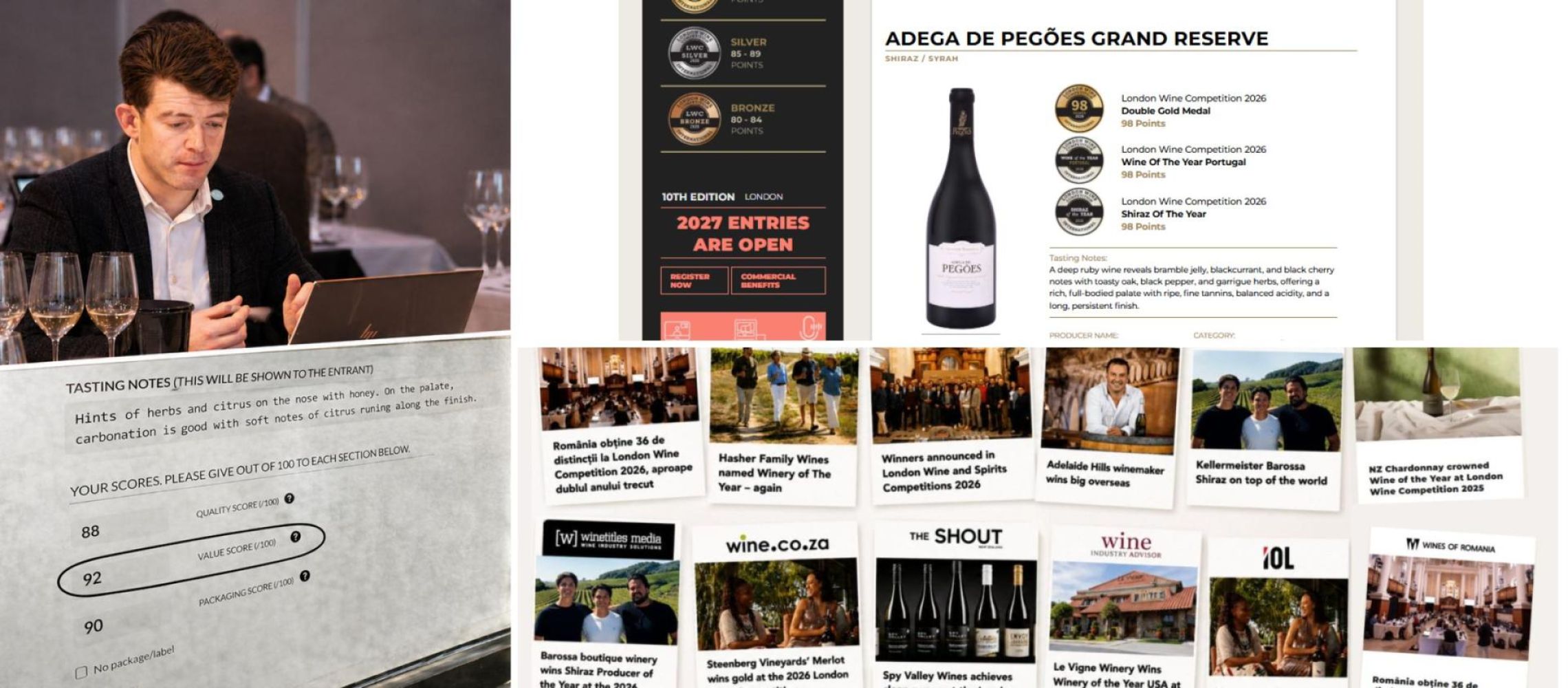
Every wine moves through a structured process—from registration and warehouse receipt to blind tasting, commercial assessment, packaging review, score calculation, feedback and results. This guide explains each stage so wineries, wine brands, importers and distributors know exactly what happens before, during and after the competition.
Every wine entered receives:
- Assessment by multiple experienced wine buyers, Masters of Wine, Master Sommeliers, sommeliers and other leading trade professionals
- Independent scores for Quality, Value and Packaging
- A final weighted score, with Quality given twice the weight of Value and Packaging
- A detailed breakdown showing how the wine performed under each judging criterion
- Professional tasting notes
- A downloadable shelf talker
- Constructive feedback on How to Improve the Product
- Commercial feedback on How to Market and Sell the Product
- Details of the judges who assessed the wine
- Access to the exclusive Buyer Market Intelligence Report
- A dedicated product page on the London Wine Competition website
- The ability to add retailer and online purchase links to the product page to help consumers find and buy the wine
- Consideration for a Bronze, Silver, Gold or Double Gold medal
- Consideration for eligible special, country, varietal, style, producer and trade awards
Winning wines also receive:
- Official digital medal artwork
- A downloadable medal certificate
- The option to order physical medal stickers
- Opportunities for promotion through the London Wine Competition and Beverage Trade Network’s media ecosystem
- Award assets that can be used in buyer presentations, distributor outreach, retail listings, websites, online stores, social media and point-of-sale campaigns
Your entry fee provides much more than the opportunity to win a medal. Every wine receives professional evaluation, transparent scoring, tasting notes, a shelf talker, actionable feedback, buyer market intelligence and a dedicated product page with purchase links that can help drive online sales. Winners also receive official award assets and promotional opportunities to help turn their results into greater trade and consumer visibility.
The journey begins by creating an account in the London Wine Competition Entrants Zone.
Once logged in, entrants complete their company profile and provide the information required for invoicing, communication and publication of results.
The entrant can then begin adding wines. Each wine is entered separately so that it can be allocated the correct category, assessed by the appropriate judging panel and published accurately if it wins an award.
Entrants should check all company and wine details carefully. The information submitted at this stage may later be used on certificates, result pages, tasting notes and other competition materials.
Create your London Wine Competition account and enter your wines.
For every wine entered, the entrant will be asked to provide essential product information. This may include:
- Brand and product name
- Producer or winery
- Country and region of origin
- Grape variety or blend
- Vintage
- Wine style and competition category
- Alcohol percentage
- Suggested retail price
- Bottle size
- Product image
- Label or packaging information
- Importer or distributor information, where applicable
Accurate retail pricing is particularly important because Value is one of the three judging criteria. Judges assess whether the quality delivered by the wine represents good value at the price supplied by the entrant.
Entrants should provide the normal retail price at which the wine is, or is expected to be, sold. The Value score is not simply a reward for inexpensive wines. A premium wine can receive a strong Value score when judges believe its quality, positioning and drinking experience justify its price.
Selecting the correct category is also important. It ensures that the wine is placed in an appropriate flight and considered in the correct context.
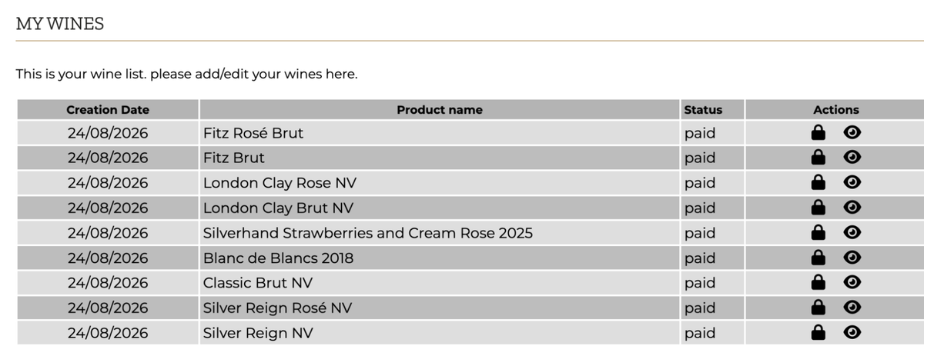
After all wines have been added, the entrant reviews the submission and proceeds to payment.
Entrants can review the current schedule and entry fees on the Key Deadlines and Pricing page.
Payment can be completed online or by bank wire. Once the payment is confirmed, the receipt or invoice becomes available in the Billing section of the Entrants Zone. The official submission labels are also generated after payment.
An entry is not complete until the wine has been registered, paid for, and delivered to the competition warehouse before the applicable deadline.
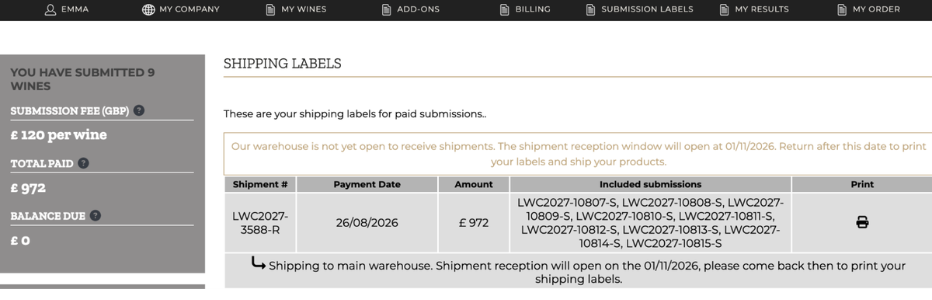
After payment, entrants can log in and open the My Submission Labels section. Over there, you will see your shipping labels.
The official London Wine Competition submission label must be downloaded and attached clearly to every shipping box. The warehouse address is displayed on the submission label once payment has been completed. The submission label is to identify your products. It is NOT a courier shipping label, you must chat with your courier for their own shipping labels that you need to attach.
The label allows the warehouse team to identify:
- The entrant
- The wines contained in the shipment
- The relevant competition
- The number of entries being delivered
Entrants should not ship samples without the official label. A clearly labelled shipment is much easier to identify, check and allocate correctly when it reaches the warehouse.
Entrants must send two bottles per entry to the address shown on the submission label.
Samples for the competition must arrive at the warehouse by the warehouse deadline date. The warehouse is located in Kent, and its receiving hours are:
- Monday to Thursday: 9:00 am to 4:00 pm
- Friday: 9:00 am to 12:00 pm
The shipping label must be attached to every box. Once the samples have been dispatched, entrants should send the courier tracking details to the competition coordinator at benjamin@londonwinecompetition.com.
The warehouse address is on the submission label that you will be able to see once you complete your payment. Please ship the wines to that address.
International entrants must ensure that shipping costs, duties, taxes and customs charges are prepaid. Samples should be sent Delivered Duty Paid so that unpaid charges do not delay or stop the shipment.
Entrants remain responsible for tracking their shipments and ensuring that samples arrive safely and on time. Wines arriving after the warehouse deadline may not be accepted, and entry fees cannot be refunded because of late, lost, held, or damaged shipments.
Complete requirements are available on the official Shipping Information page
When the samples reach the warehouse, the operations team matches them against the entrant’s submission records.
The team checks that the correct wines and required number of bottles have arrived. Samples are then recorded, organised and prepared for judging.
Before judging, wines are grouped into suitable flights. Flights may be organised by factors such as style, grape variety, region or other relevant product characteristics. This enables judges to assess wines in a logical and consistent sequence.
The bottles used for the first stage of judging are prepared for blind tasting. Branding, bottle design and packaging do not influence the initial Quality assessment.
Each wine is evaluated by multiple judges with relevant wine and commercial experience.
London Wine Competition judges include Masters of Wine, Master Sommeliers, wine buyers, importers, distributors, retailers, sommeliers and other professionals involved in selecting, listing, recommending or selling wine.
Every judge assesses and scores the wine independently. Where required, judges can discuss a wine as a panel to refine their evaluations, create greater consistency and arrive at a fair commercial consensus.
The final result does not come from one person’s opinion. It reflects the combined assessment of several experienced professionals.
Quality is always assessed first.
Judges receive the wine in a tasting glass without seeing its bottle, label, brand or packaging. At this point, they focus entirely on the wine in the glass.
Quality is marked out of 100, with judges considering:
- Appearance
- Aroma
- Body and structure
- Taste
- Balance
- Mouthfeel
- Finish and aftertaste
- Overall drinking experience
- Suitability for the wine’s intended consumer
The judging screen does not reveal the packaging while the Quality score is being decided.
Once satisfied with their assessment, judges enter and submit their Quality score. Only after the Quality score has been recorded can the process move forward.
This sequence protects the integrity of the tasting. An attractive label, well-known brand, or premium-looking bottle cannot influence the judges’ assessment of the wine itself.
[[relatedPurchasesItems-68]]
After submitting the Quality score, judges are shown the wine’s retail price.
They then assess Value, also out of 100.
The Value score asks a practical commercial question:
Does this wine deliver an appropriate or exceptional drinking experience at its intended retail price?
Judges consider the relationship between the wine’s quality and its price rather than simply rewarding the lowest-priced product.
A competitively priced everyday wine can score highly when it overdelivers for its price. A premium wine can also score highly when its quality, complexity, positioning and overall experience justify the higher price.
At this stage, the tasting remains blind. Judges know the retail price but still do not see the brand, bottle or label.
They complete the Quality and Value scores for all wines in the flight before requesting the retail packages.
Only after Quality and Value have been completed are the packaging bottles brought to the judging table.
The judges now receive the complete, unopened retail package exactly as a buyer or consumer would see it in the market.
Judges can stand the bottle on the table, pick it up, touch it and examine it from every angle. They can review the front label, back label, closure, bottle shape, information hierarchy, visual identity and overall presentation.
Panel members may also discuss how effectively the packaging communicates:
- The wine’s identity and style
- Its intended price position
- Its target consumer
- Its country, region or origin
- The clarity of essential information
- Its shelf visibility
- Its credibility and commercial appeal
- Whether the presentation is appropriate for the off-trade market
Packaging is not judged as an isolated design exercise. Judges consider how the complete pack would perform when placed on a retail shelf alongside many competing wines.
They then enter a Packaging score out of 100.
This sequence means each part of the wine is evaluated at the correct time:
1. Quality: Blind tasting with no brand, price, or packaging influence
2. Value: Retail price revealed after Quality has been submitted
3. Packaging: Complete retail package reviewed after Quality and Value are complete
Every judge independently gives the wine:
- A Quality score out of 100
- A Value score out of 100
- A Packaging score out of 100
The individual scores submitted by all judges who assessed the wine are then averaged.
For example, the final Quality score is the average of the Quality scores submitted by the judges. The same process is used to determine the final Value and Packaging scores.
Quality is given twice the weight of Value or Packaging. The wine’s final competition score is calculated using:
Final Score = (Quality × 2 + Value + Packaging) ÷ 4
This weighting recognises that the wine in the glass must remain the most important part of the result while still reflecting the commercial realities of price and presentation.
The detailed London Wine Competition judging process explains how the three criteria are assessed.
The final weighted score determines whether the wine receives a medal:
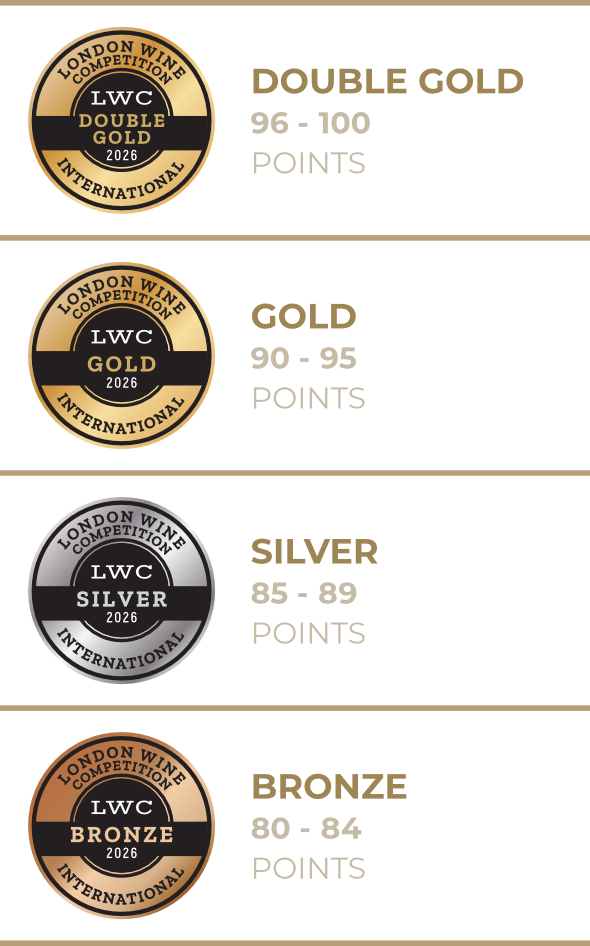
- Double Gold: 96–100 points
- Gold: 90–95 points
- Silver: 85–89 points
- Bronze: 80–84 points
The competition also presents a range of major, country, varietal, style, producer and trade awards. Depending on eligibility and the number and performance of wines entered, a company may be considered for awards such as Wine of the Year, Winery of the Year, Best Wine by Country, Best Wine by Varietal, Style Producer of the Year, Importer of the Year, Agency of the Year or Own Label awards.
Some producer and trade awards require a minimum number of entries, medals or average score. Entrants seeking these titles should review the Awards and Qualification Criteria before deciding how many wines to enter.
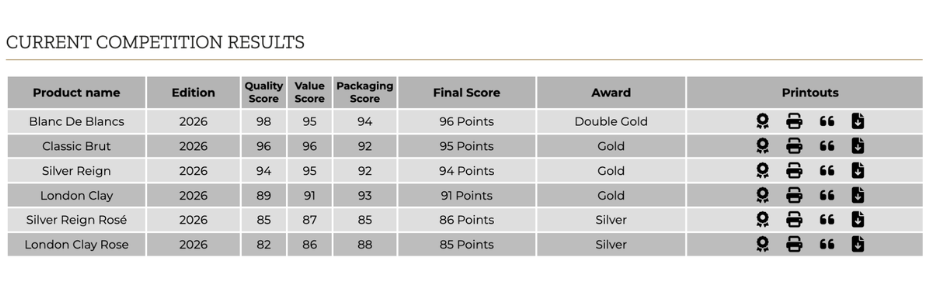
The London Wine Competition winners are scheduled to be announced as per the keydates.
Entrants can log in to their account to view the outcome for each wine. You will also be able to see the winners on the main website home page under the menu tab Winners.
Every entrant can see the detailed breakdown showing how the wine performed across the three main criteria in their entry zone, along with all the below things in the entry zone:
- Quality
- Value
- Packaging
- Final weighted score
- Medal result, where applicable
- Certificates
- Medal artwork
- Medal stickers if you want to buy
- Shelf talkers
- Buyers market report
- Detailed feedback on each product, which also includes who judged your products
- Marketing add-ons and advertising opportunities
On the public page, you will see the final score
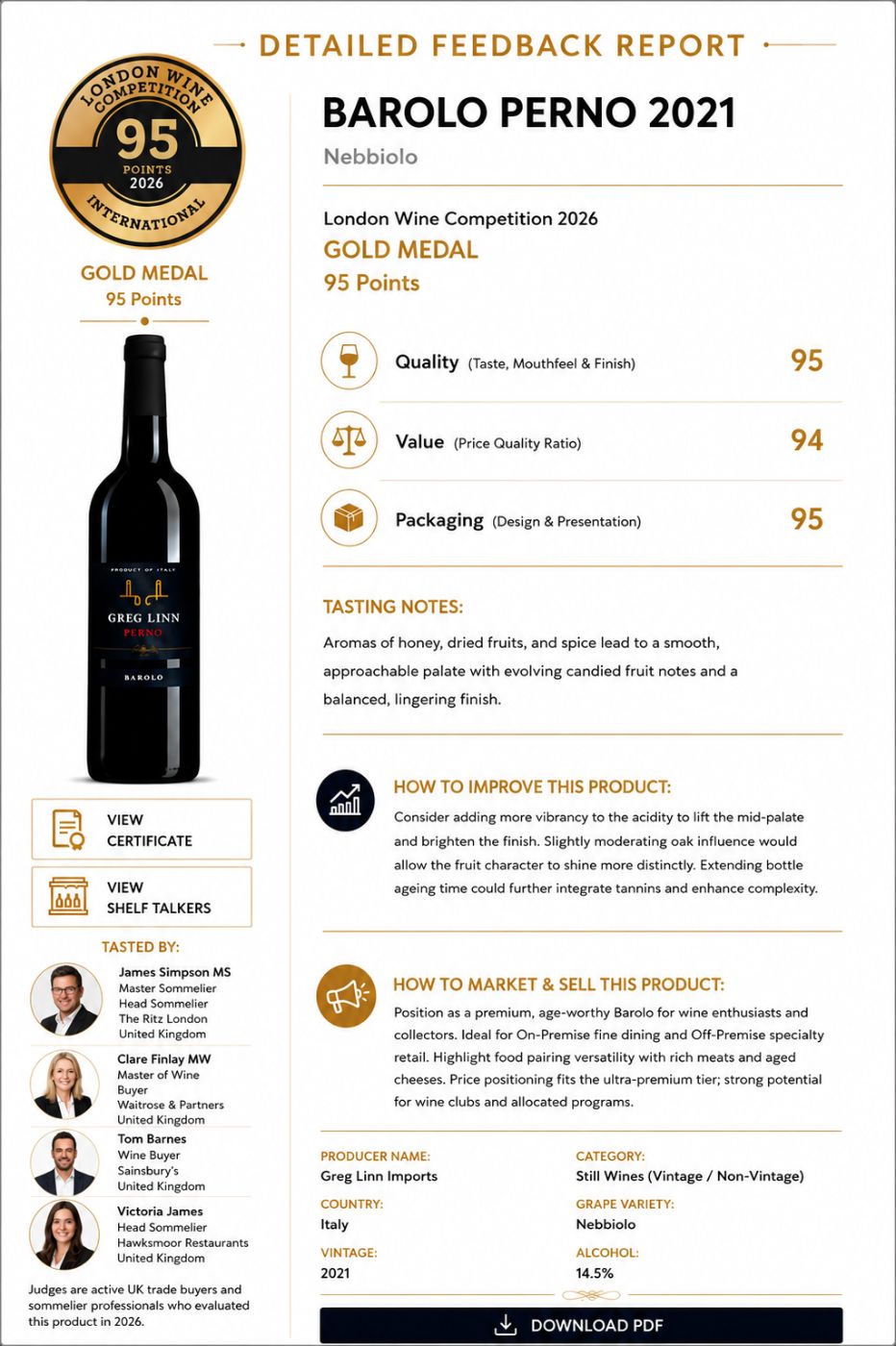
The London Wine Competition is giving entrants more information beyond their medal and score.
Each entered product receives two additional forms of structured, buyer-led feedback:
Judges provide concise and constructive recommendations that may cover areas such as wine quality, flavour balance, pricing perception, packaging, shelf appeal, positioning or general market readiness.
The purpose is to help producers understand what could be strengthened before the wine’s next release, market presentation or competition entry.
Judges also provide commercially focused feedback on how the wine may be positioned and sold, particularly in the UK market.
This may include observations about:
- Target consumers
- Retail or on-trade suitability
- Pricing position
- Shelf placement
- Route to market
- Independent retail opportunities
- Potential fit with larger chains
- Distributor appeal
- The strongest elements of the wine’s commercial story
Products may also display the names of the judges who evaluated them, providing greater transparency about the professional perspectives behind the assessment.
More details are available in the announcement on expanded feedback and judge transparency.
Winning wines can use their results to support conversations with importers, distributors, retailers, restaurants and consumers.
Depending on the result, entrants can access assets including:
- Official digital medal artwork
- Medal certificate
- Professional tasting notes
- Printable shelf talkers
- Online winner and product pages
- Results and score information
- Opportunities to order physical medal stickers
The official product page provides a long-term digital record of the wine, including its product information, award, score and tasting notes. These pages can be shared in sales presentations, distributor outreach, trade communications, newsletters and social media campaigns.
Winners can also use medal artwork on approved sales and marketing materials, including sell sheets, brand decks, websites, online stores, bottle neckers, case cards and point-of-sale materials.
The competition promotes results through its website, social channels and Beverage Trade Network’s media ecosystem. Further details are available on the Entry Benefits page.

The London Wine Competition entrant journey begins with a registration form, but its real purpose is to provide a professional assessment of how a wine may perform in the market.
The wine is first judged entirely on what is in the glass. Its retail price is then introduced so judges can assess Value. Only after those decisions have been recorded is the complete package reviewed.
Multiple judges score each wine independently. Their scores are averaged, Quality receives double weight, and the entrant receives a detailed result showing how the wine performed across every criterion.
For winners, the medal becomes a tool that can be used across sales, distribution, retail, marketing and consumer communication. For every entrant, the score breakdown and expanded feedback provide practical insight into the wine’s quality, pricing, presentation and commercial potential.
That is the complete journey: from registering a wine to understanding how experienced wine professionals believe it will taste, compete, sell and stand out in the marketplace.
Start your journey by entering the London Wine Competition. London Wine Competition goes beyond the medal by giving you a lot more transparency and benefits for your entry.
Also Read:
How London Wine Competition Judging Really Happens: Quality, Value and Packaging Explained
London Wine Competition Launches Exclusive Buyer Market Intelligence Report For Entrants
More Feedback and Transparency For Entrants At London Competitions
The 2027 London Wine Competition gives every entrant greater feedback, transparency and commercial insight. Entrants will receive an expanded score breakdown, constructive feedback on how to improve, guidance on how to market and sell their wines, the names of the judges who tasted their entries, final feedback from the Head Judge and a Buyer Market Intelligence Report.
Enter your wines in the 10th edition of the London Wine Competition.